
Data and AI Horizon 2026: The Enterprise Readiness Imperative

Data and AI Horizon 2026: The Enterprise Readiness Imperative
Data & AI Strategy
Snowflake

Why 2026 Is a Turning Point for Enterprise AI

By early 2025, AI crossed a critical threshold. What was once experimental became practical, accessible, and embedded into real business workflows. As organizations move into 2026, the challenge has shifted again.

AI success is no longer limited by technology. It is limited by enterprise readiness.

Insights from Snowflake’s AI + Data Predictions 2026 make this clear: while AI capabilities continue to advance rapidly, most organizations struggle to translate those advances into consistent, enterprise-wide impact without strong data foundations, governance, and operating models.

Several forces accelerated this shift:

These advances unlocked new opportunities, but they also exposed foundational gaps in data quality, governance, and enterprise operating models.

The Evolution of AI: 2016 → 2025

To understand why enterprise readiness matters so much in 2026, it helps to look at how quickly AI has evolved over the past decade.

Early advances between 2016 and 2020 laid the technical foundation. Breakthroughs like Transformers, BERT, and early GPT models showed that large-scale machine learning could generalize across tasks. From 2021 to 2022, progress accelerated as models such as Codex, DALL·E, and GPT-3.5 demonstrated clear business value through code, image, and text generation.

The real inflection point came in 2023 and 2024. Generative AI moved into the mainstream, driven by models like GPT-4, Claude, Claude 3, and Claude 3.5 Sonnet. AI shifted from experimentation to everyday use, becoming embedded in workflows—particularly across software development.

That shift accelerated further in 2025. Tools like Claude Code saw rapid adoption and feature expansion, signaling a move from AI-assisted coding to AI-native development. Capabilities pioneered by OpenAI Codex were increasingly absorbed into general-purpose models, speeding adoption across engineering teams.

This period also marked a move beyond text. Multimodal and generative video models—including Sora, Sora 2, and Google’s Veo 3—showed that AI could reason and generate across visual, audio, and temporal inputs, expanding enterprise use cases well beyond language and analytics.

AI is now embedded in core business processes. Automation and augmentation are operational, supported not only by more capable models (Claude Opus 4.5, GPT-4.5–5.2, Gemini 3, DeepSeek-R1, DeepSeek V3.2), but by maturing infrastructure designed for scale.

Tooling for agentic systems also advanced rapidly. Frameworks such as OpenAI’s Agents SDK, emerging Claude agent tooling, and protocols like MCP helped standardize how AI systems plan, execute, and interact with enterprise data and tools. Combined with orchestration layers, LLM gateways, and observability tools, these advances made AI systems easier to deploy, govern, and monitor in production.

The takeaway is clear: model innovation is no longer the constraint. The challenge for 2026 is execution—building the platforms, data foundations, and governance required to scale AI across the enterprise.

Trends Defining Enterprise AI in 2026

TREND 1

Enterprise-Ready AI Platforms

Foundation models are now the backbone of modern AI strategies. Snowflake’s report emphasizes that large language and reasoning models have matured to the point where they can support production workloads across industries, if enterprises are prepared to operationalize them.

Models such as GPT, Gemini, Claude, and Llama now offer:

In 2025, these capabilities made AI experimentation easy. In 2026, they enable platform-based AI adoption.

This shift was supported by the maturation of LLM infrastructure:

Together, these advances allowed enterprises to move beyond isolated implementations toward repeatable, governed AI platforms. Leading organizations are now:

Snowflake highlights this shift as a move from isolated AI wins to connected AI ecosystems, where value compounds across the enterprise. This transition—from projects to platforms—is what enables scale, consistency, and governance.

Industry Callouts

Financial Services

Snowflake predicts a return to a data-first mindset, with AI platforms supporting fraud detection, compliance, and customer intelligence, while maintaining auditability and regulatory controls.

Healthcare & Life Sciences

Enterprise-ready AI platforms enable clinical documentation, medical research, and analytics, while respecting strict governance and privacy requirements.

Manufacturing

AI platforms power quality inspection, predictive maintenance, and operational analytics across plants and supply chains, building on years of foundational data work.

Private Equity

Shared AI platforms accelerate diligence, portfolio monitoring, and value-creation initiatives across multiple investments.

TREND 2

Data Readiness Limits AI Scale

As foundation models reduce the technical barrier to entry, data readiness becomes the primary constraint on enterprise AI success.

Snowflake’s research repeatedly reinforces this point: organizations with governed, high-quality, and well-understood data will scale AI faster—and more safely—than those still addressing basic data challenges.

General-purpose AI is powerful, but enterprise value depends on domain-specific accuracy.

Fine-tuning and domain adaptation allow organizations to customize AI for their business without building models from scratch:

Snowflake also notes that agentic AI is especially sensitive to gaps in enterprise data and undocumented decision logic, making data readiness a prerequisite for autonomy.

Industry Callouts

Financial Services

Fine-tuned models improve accuracy in credit risk, AML, and regulatory reporting; areas where errors carry real consequences.

Healthcare & Life Sciences

Domain-specific AI enhances clinical documentation, trial analysis, and diagnostics, where precision and traceability are essential.

Manufacturing

Fine-tuning supports defect detection, root-cause analysis, and plant-specific optimization.

Private Equity

Domain-adapted AI accelerates deal review, contract analysis, and operational benchmarking across portfolios.

TREND 3

Multimodal and Agentic AI Advance

Multimodal and agentic AI represent the most visible evolution of AI capability. Snowflake describes agentic AI as the shift from systems that generate responses to systems that reason, plan, and act more like coworkers than tools.

Early enterprise use cases already include:

Despite rapid progress, Snowflake predicts that 2026 will be defined by measured adoption, not full autonomy. Why?

The most successful organizations will deploy agents in bounded, high-confidence scenarios, with humans firmly in the loop.

Industry Callouts

Financial Services

Agentic AI supports customer inquiry triage, fraud alert investigation, and reporting workflows, with human oversight required for regulated decisions.

Healthcare & Life Sciences

Multimodal AI improves clinical documentation and administrative workflows, while agentic use remains limited to non-clinical, low-risk processes.

Manufacturing

Agentic systems optimize scheduling, inventory, and quality monitoring by combining sensor data, images, and operational metrics.

Private Equity

Multimodal and agentic AI accelerates diligence, reporting, and portfolio monitoring, while investment decisions remain human-led.

BONUS: TREND 4

Physical AI Begins to Emerge

While most enterprise AI progress has focused on software, data, and digital workflows, physical AI and robotics are beginning to show meaningful signs of progress.

The most visible advances are in fully autonomous vehicles. Robotaxi deployments, led by companies like Waymo, represent a major milestone in physical AI: systems that can perceive, reason, and act in complex real-world environments with minimal human intervention. While still geographically constrained, these deployments demonstrate how far perception, planning, and real-time decision-making have advanced.

Drones are another area of rapid improvement. Companies such as Amazon have invested heavily in autonomous drone technology, applying AI to navigation, obstacle avoidance, and delivery logistics. These systems highlight the potential of physical AI in last-mile operations, while also underscoring the challenges of safety, regulation, and real-world variability.

For enterprises, the takeaway is: physical AI is advancing, but still early. Unlike software-based AI, physical systems amplify risk, require extensive testing, and demand high-confidence data. Organizations that succeed in physical AI will be those that invest early in data foundations, governance, and operational readiness, long before autonomy becomes widespread.

Strategic Recommendations

AI is no longer optional. The barrier to entry has fallen, and competitive advantage now depends on execution. The path forward is clear:

Focus on high-value opportunities

Prioritize AI use cases tied directly to business outcomes.

Start small, but design for scale

Launch pilots with clear success metrics while building toward shared platforms.

Invest in data readiness

AI outcomes depend on data quality, governance, and accessibility.

Build AI literacy across the org

Train teams to collaborate with AI, not just use tools.

Treat governance as an enabler

Clear guardrails accelerate adoption by building trust and reuse.

TL;DR

Turn Insight Into Impact

AI capabilities are no longer the limiting factor; enterprise readiness is. AI is entering its next phase, defined by scale, governance, and real business impact.

OneSix helps organizations build the data foundations, AI platforms, and governance models required for enterprise adoption. Whether you’re moving beyond pilots or preparing for agentic AI, our experts can help you turn strategy into execution.

Written by

Jacob Zweig, Managing Director

Published

December 17, 2025
Snowflake Cortex Search vs. Custom RAG

Snowflake Cortex Search vs. Custom RAG

Choosing the Right Approach for Enterprise AI

AI & Machine Learning
Data & AI Strategy
AI Agents & Chatbots
Forecasting & Prediction
Snowflake

Enterprise adoption of AI is moving quickly, but leaders face a critical question: how do we ground large language models (LLMs) in enterprise data while keeping solutions scalable, accurate, and cost-effective?

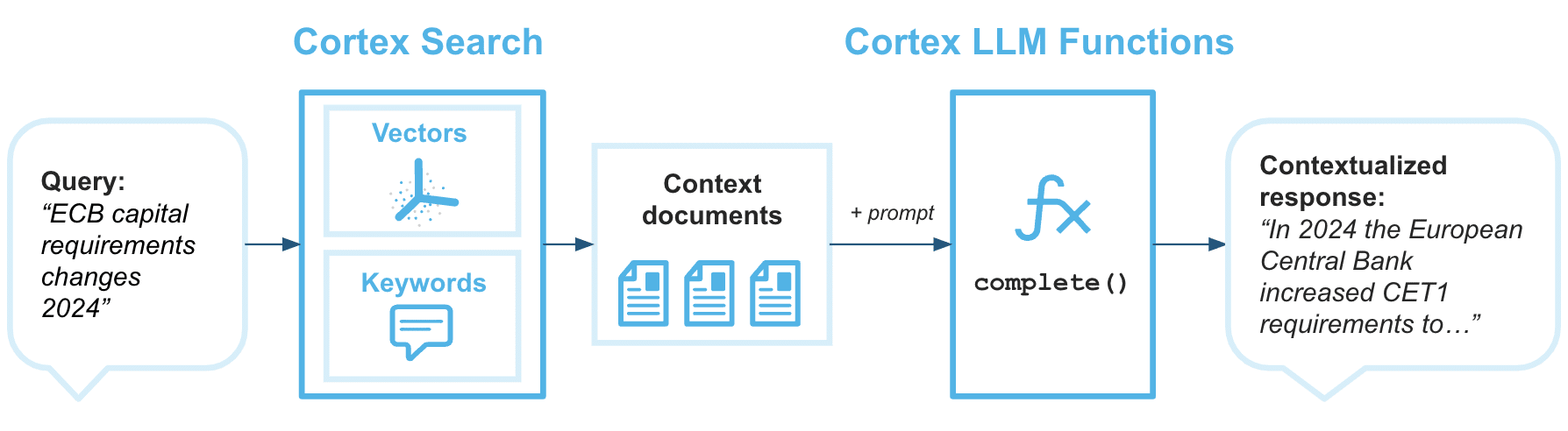
Snowflake’s Retrieval-Augmented Generation (RAG) and enterprise search solution, Cortex Search, and custom RAG pipelines represent two different approaches to solving that challenge. Understanding how they work—and when each is the right fit—is essential for any organization investing in enterprise-ready AI.

The debate begins with a shared starting point: RAG enables LLMs to leverage enterprise data effectively.

What is RAG?

Retrieval-Augmented Generation (RAG) is the process of giving an LLM access to relevant, external information so it can answer queries more accurately.

The typical RAG workflow looks like this:

The value of RAG is that it allows standard, off the shelf models to deliver high-quality, context-aware answers based directly off of your data—whether it’s the latest company policy, current product details, or niche industry knowledge.

Why RAG Matters Now

Enterprise AI adoption is accelerating, but models alone are not enough. RAG has become essential because it:

In other words, RAG is the bridge between broad LLM capability and business-specific intelligence.

The Rise of Enterprise-Ready AI 

Snowflake Cortex arrives at a moment when enterprise AI adoption is shifting from experimentation to scale. According to Gartner’s Emerging Tech Impact Radar: Generative AI (2025), one trends stand out that will fundamentally change how enterprises adopt and operationalize AI: AI marketplaces will reshape how enterprises buy AI.

By 2028, 40% of enterprise purchases of AI assets—models, training data, and tools—will be made through AI marketplaces, up from less than 5% in 2024. This shift will make AI assets more accessible, but it also introduces new questions: 

As enterprises weigh these decisions, the opportunity is clear: managed services like Cortex Search make it faster than ever to get started, but selecting the right approach—and understanding the tradeoffs—remains critical to long-term success.

The Big Question

With both Cortex Search and custom RAG pipelines available, leaders face a critical decision: When should you use Cortex Search, and when does a custom RAG pipeline make more sense?

The Case for Cortex Search

For many enterprises already running on Snowflake, Cortex Search offers the fastest path to RAG. It delivers a “batteries included” experience with embedding, chunking, document parsing, and auto-updates handled natively inside the Snowflake Data Cloud.

Strengths

Best Fit For

Cortex Search is best suited for teams that:

Key Considerations

When evaluating Cortex Search, organizations should consider:

These considerations highlight the importance of aligning the right approach to the right use case, helping organizations get the most out of Cortex Search today and in the future.

The Case for Custom RAG

While Cortex Search is designed to cover a wide range of enterprise use cases, some organizations encounter requirements that go beyond its current scope. In those cases, a custom RAG architecture may be the right fit.

Strengths

Best Fit For

Custom RAG is best suited for enterprises that:

Tradeoffs

The tradeoff for flexibility is complexity. Custom RAG requires:

Choosing the Right Approach

Enterprises evaluating RAG often face a decision between Cortex Search, Snowflake’s managed turnkey option, and a Custom RAG architecture built for flexibility and control. 

The right choice depends on the end goal: aligning the approach to the use case ensures organizations get the most value from their investment.

This comparison can be viewed from two angles: (1) feature differences such as setup, scaling, and control, and (2) evaluation criteria that guide leaders in choosing the best fit for their priorities.

Cortex Search vs. Custom RAG

Setup, scale, and control at a glance.

FeatureCortex SearchCustom RAG
SetupTurnkey (SQL functions, auto-updates)Complex (vector DB, pipelines, orchestration)
Supported DataText (PDF, DOCX, JPG, PNG → text only), 512 tokensMulti-modal (text, image, audio, video)
Scaling100M chunks maxUnlimited, depends on infra
ControlLimited, black-boxFull flexibility
Best UseRapid POCs, Snowflake-native appsCustom enterprise AI, domain-specific

A Hybrid Approach

For many enterprises, the best path is not either/or, but both. Cortex Search provides a fast, Snowflake-native way to launch retrieval-augmented applications with minimal setup. As needs grow — more data types, domain-specific performance, or advanced retrieval strategies — a custom RAG architecture can extend those foundations without starting over.

Aligning Approach to Use Case

The key is alignment: matching the approach to the use case. Whether the priority is speed, scale, or specialization, organizations can maximize value by choosing the right starting point and planning for future flexibility.

The Path Forward

Every enterprise’s journey with AI looks different. Whether you start with Cortex Search, scale with Custom RAG, or combine both, the key is choosing an approach that aligns to your business goals. That’s where OneSix comes in.

Written by

Osman Shawkat, Senior ML Scientist

Published

September 22, 2025

Expert Guidance,
Real-World Implementation

We help enterprises choose the right AI approach and make it real. Our team of senior engineers and PhD-trained scientists designs, deploys, and scales solutions that deliver impact fast.

Contact Us

It’s Not Your Tech Stack: 6 Questions Every Data Leader Should Ask

It’s Not Your Tech Stack: 6 Questions Every Data Leader Should Ask

Data & App Engineering
Data Analytics
Data & AI Strategy

Many leaders we talk to, whether they’re CTOs, CDOs, or Heads of Digital Transformation, share the same concerns:


It’s tempting to believe that a new platform, dashboard, or AI tool will solve these challenges. Technology vendors certainly promise it: Be more efficient! Lower costs! Unlock more value!

But while tools help, they’re not enough. 

Success comes down to people and process first. Without them, even the most advanced platforms will underdeliver. 

6 Questions to Ask Before You Add Another Tool

If you’re evaluating new technology, first take a step back:

1. Do we have clarity of ownership?

A simple RACI matrix across your data, IT, and business teams eliminates ambiguity.

2. How are we measuring success?

Can we clearly state which problem this technology is meant to solve, and how we’ll measure whether it’s working?

3. Do we have a “Council of Data”?

Regular touchpoints between leaders align priorities and reduce friction.

4. Do we manage requests consistently?

Clear processes for intake, prioritization, and delivery improve both speed and code quality.

5. Are we upskilling our people?

Investing in training ensures your team can maximize today’s stack and prepare for tomorrow’s.

6. Are we fully leveraging the tools we already have?

Before adding new technology, evaluate whether your existing platforms can solve the problem. Many tools have underused features that, when adopted, can deliver the outcomes you’re looking for without adding more complexity.

Technology is never a silver bullet. Tools will come and go, but what drives lasting impact are the foundations you set with your people and processes. Get those right, and any technology you choose becomes an enabler, not the solution.

Why This Matters

Our experience at OneSix is that organizations who treat data transformation as people + process + technology see greater ROI, faster adoption, and less wasted spend.

The next time a vendor promises a shiny new fix, pause and ask:

Are our teams and processes ready to make it successful?

Unlock the Full Value of Your Data Investments

True transformation happens when people and processes come first, and technology becomes the enabler. At OneSix, we help leaders build that balance. Let’s explore together.

Contact Us
Written by

Jonathan Kolar, Senior Lead

Published

September 2, 2025

Beyond the Prompt: Why Your RAG System May Be Underperforming

Beyond the Prompt: Why Your RAG System May Be Underperforming

This is Part 1 of a three-part series:

AI & Machine Learning
Data & AI Strategy
AI Agents & Chatbots
Forecasting & Prediction

Faced with the question “What is the capital of the Netherlands?” you have a few possible responses:

1


Answer confidently
If you know it

2


Look it up
If uncertain

3


Take a guess
Might be wrong


Large Language Models (LLMs) face the same challenge. They excel when a question falls inside their training data, but when it doesn’t, they may “hallucinate,” producing an answer that sounds plausible but is wrong. 

The key difference is that LLMs don’t have direct access to your enterprise data or knowledge bases without additional retrieval methods. That’s where Retrieval-Augmented Generation (RAG) comes in.

RAG in a Nutshell

RAG is the process of giving an LLM access to relevant, external information so it can answer queries more accurately. The typical RAG workflow looks like this:

The value of RAG is that it allows models of any size to deliver high-quality, context-aware answers, whether it’s the latest company policy, current product details, or niche industry knowledge. But RAG doesn’t operate in isolation. For RAG to deliver consistently, it needs to be part of a well-designed information environment, also known as context engineering.


The Shift from Prompt to Context Engineering

In the early days, “prompt engineering” was the art of crafting the right wording to get the right answer. But as AI systems have grown more complex, the industry has realized that context quality of context matters more than the cleverness of the prompt.

Context engineering builds the full information environment around the LLM, not just the immediate instruction, but also system settings, past conversation history, retrieved documents, tools, and output formats.


Prompt Engineering
Shaping single-turn prompts for answers


Context Engineering
Shaping context for multi-step tasks


RAG is a critical part of context engineering, ensuring that the model’s “world” includes the exact information needed for the task.

It’s Not Your RAG, It’s Your Context

In real-world deployments, many RAG systems disappoint, and the issue is almost never the model. It’s bad context engineering. Common pitfalls include:

Imagine an AI system reviewing legal contracts that confidently reports a key clause is missing. In reality, the clause exists, but the retrieval process never pulled it into the model’s context. This kind of gap shows why careful retrieval design is essential.

Engineering Retrieval for Success

Preventing these failures starts with designing retrieval around the business use case:

Done well, RAG produces grounded, fresh, scalable, and personalized AI outputs. But in many real-world environments, not all the information you need is text. From images and videos to audio clips and charts, handling different content formats introduces new retrieval challenges — and that’s where multi-modal context comes in.

Handling Multi-Modal Context

Most embedding models are optimized for a single type of data, and text models usually outperform others. Multi-modal embeddings (for example, image plus text models) often underdeliver in production.

A surprisingly effective solution is to convert all content to text before retrieval.

For example:

By indexing text representations, retrieval accuracy for non-text content improves dramatically.

RAG in the Real World

OneSix built an AI-powered chatbot for a higher education client to help students get answers faster.


By applying RAG, the chatbot summarized thousands of unstructured documents, giving students accurate answers instantly and helping the university better serve its community.

Real-world RAG success comes from context engineering, feeding models the right information to deliver accurate, reliable, business-ready answers.

Ready to unlock the full potential of RAG?

At OneSix, we design and deploy Retrieval-Augmented Generation systems built for the real-world. We engineer context, optimize retrieval, and integrate AI into your workflows—so your models deliver accurate, reliable, measurable results.


Let’s talk about how we can turn your AI ideas into measurable results.

Contact Us
Co-written by

Matt Altberg, Lead ML Engineer
Francisco Gonzalez, Sr. Architect

Published

August 19, 2025

Using AI to Extract Insights from Data: A Conversation with Snowflake

Using AI to Extract Insights from Data: A Conversation with Snowflake

Published

February 6, 2025

During Snowflake’s World Tour stop in Chicago, Data Cloud Now anchor Ryan Green sat down with leaders from OneSix. During the conversation, Co-founder and Managing Director Mike Galvin and Senior Manager Ryan Lewis note how Snowflake’s technology has changed the game, allowing them and its customers to focus less on how to build data infrastructure and more on how to extract insights from data, be it via the use of AI or reporting or dashboarding.

Get More from Your Data with Snowflake

As a Premier Snowflake Services Partner, we drive practical business outcomes by harnessing the power of Snowflake AI Data Cloud. Whether you’re starting with Snowflake, migrating from a legacy platform, or looking to leverage AI and ML capabilities, we’re ready to support your journey.

Contact Us

Data and AI Horizon 2025: Key Trends and Tips

Data and AI Horizon 2025: Key Trends and Tips

Written by

Jacob Zweig, Managing Director

Published

December 6, 2024

Data & AI Strategy
Financial Services
Healthcare & Life Sciences
Retail & Consumer Goods
Manufacturing
Snowflake

As we enter 2025, organizations face an unprecedented convergence of technological advancements in AI, computing, and human-centered innovation. This year marks a pivotal shift from experimentation to operationalization, with a focus on measurable ROI, ethical governance, and sustainable practices. Industries from manufacturing to healthcare are leveraging these trends to drive efficiency, collaboration, and customer-centric solutions.

By embracing cutting-edge tools such as autonomous AI systems, hybrid computing architectures, and AI-driven personalization, businesses can transform operations, unlock new opportunities, and thrive in a rapidly evolving digital landscape.

Drawing on insights from Snowflake’s AI + Data Predictions 2025, Coalesce’s Top Data Trends for 2025, PwC’s 2024 Cloud and AI Business Survey, and Gartner’s Top 10 Strategic Technology Trends for 2025, this guide explores key trends, industry-specific impacts, and strategic recommendations to help leaders navigate and harness the transformative potential of 2025.

Table of Contents

Top 3 Trends

TREND 1

Practical, Value-Focused AI

AI remains a cornerstone of innovation, but 2025 marks a decisive shift from exploratory projects to operationalized solutions that deliver measurable ROI.

Aligning AI with Business Goals

Over the past two years, businesses faced immense pressure to rapidly adopt AI technologies, driven by demands from investors, boards, and executives. This rush often resulted in disjointed experiments with tools like ChatGPT, revealing both the potential and the challenges of unstructured adoption. Now, companies are recalibrating their focus, aligning AI initiatives with broader data strategies for strategic, well-defined outcomes.

“People are coming to the realization that building an AI solution is very easy, but building an AI solution that actually adds value is much more difficult.”

Governance as a Foundation

Ethical AI governance is no longer optional. Transparent guardrails and accountability are critical to mitigate risks like bias and data poisoning while fostering stakeholder trust.

“You can have a use case with AI, but if you have not put the right guardrails around that and understood governance and responsible AI, then obviously you leave yourself exposed as an organization. It’s really all about governance and transparency.”

Generative AI and Automation

Generative AI and autonomous agents are transforming productivity by automating workflows, streamlining repetitive tasks, and introducing novel use cases. Tools like Retrieval-Augmented Generation (RAG) enhance reliability by grounding outputs in verifiable data, addressing the challenge of hallucinations.

67%

of top-performing companies are already realizing value in using GenAI for products and services innovation.

TREND 2

Seamless Data Architectures

Effective AI relies on data architectures that are robust, scalable, and interoperable. These architectures ensure seamless data integration and processing, enabling AI to deliver reliable and impactful outcomes.

Unified Storage for Seamless Processing

Organizations are adopting unified storage solutions that integrate with multiple compute engines, enabling consistent, efficient data processing across diverse systems.

“AI models require large amounts of clean, high-quality data to function effectively and produce accurate results. Enterprises will increasingly leverage user-friendly data integration tools to centralize data from various operational data stores to create a corpus for AI training.”

The Rise of Open Table Formats

Open-source table formats like Apache Iceberg are the future of data architecture because they provide for enhanced governance and interoperability across various data platforms. Data platform leaders like Snowflake are rapidly adding features to leverage the power of Iceberg.

“Iceberg will go mainstream and finally combine operational and analytical data.”

TREND 3

Human-Centered AI Innovation

In 2025, technology will go beyond operational efficiency to reshape how humans work, collaborate, and engage with technology. Human-centered innovation empowers individuals through intuitive systems, driving unprecedented productivity and creativity.

Intelligent Workforce Automation

In 2025, technology will go beyond operational efficiency to reshape how humans work, collaborate, and engage with technology. Human-centered innovation empowers individuals through intuitive systems, driving unprecedented productivity and creativity.

“If you talk to developers about the software development lifecycle, across the design, development and testing phases, you’ll learn that pretty much no one likes QA. Good QA is very cumbersome and time consuming. If we can offload 40% or more of the testing process to an AI-powered assistant — with human supervision and assurance — we move faster, and developers spend more time doing what they love to do.”

Enhanced Team Collaboration

AI and data platforms are fostering a new wave of collaboration. Fusion teams, which combine technical and domain expertise, are driving efficient AI applications and bridging departmental gaps. Real-time data sharing enables informed decision-making and cultivates a culture of innovation.

Personalized Experiences at Scale

AI is tailoring experiences to individual needs, from customized training programs to hyper-personalized customer engagement. These advancements elevate user satisfaction, accelerate skill acquisition, and create impactful business outcomes.

“AI will transform how brands personalize and automate every step of the customer journey. Marketers will move past manual A/B testing and static targeting, embracing ML-driven experiences that continuously learn and adapt for each user.

Industry Impacts

Manufacturing

Manufacturing will experience significant advancements with the adoption of large vision models—AI systems capable of interpreting visual inputs. These technologies will:

Financial Services

Financial services will continue to lead in AI adoption but with a focus on balancing innovation and fiscal responsibility:

Healthcare and Life Sciences

Healthcare and life sciences will adopt AI cautiously, focusing on measured applications to ensure safety and compliance:

Retail and Consumer Goods

The retail industry will focus on incremental successes with AI to address challenges and enhance customer experiences:

Strategic Recommendations

Focus on Practical Applications

Learn from early adopters and prioritize use cases with measurable outcomes.

Invest in Governance

Implement frameworks that ensure ethical AI usage and compliance with regional regulations.

Embrace Open Source

Adopt open standards like Iceberg to enhance collaboration, interoperability, and vendor independence.

Upskill the Workforce

Equip teams with the skills to leverage AI and advanced computing for strategic problem-solving.

Adapt Business Models

Align organizational strategies with emerging technologies to stay competitive.

From Insight to Impact

As we navigate the horizon of 2025, the convergence of data, AI, and innovation presents organizations with immense opportunities to transform their operations and unlock new avenues of growth. By embracing these shifts, leaders can position their organizations to thrive in a rapidly evolving digital landscape. Connect with our experts today to start building a future-ready data and AI strategy that combines innovation and practicality.

Contact Us

Culture Matters: Building a Data-Driven, AI-Powered Mindset in Private Equity

Culture Matters: Building a Data-Driven, AI-Powered Mindset in Private Equity

Written by

Mike Galvin, Managing Director

Published

October 9, 2024

Data & AI Strategy
Portfolio AI Strategy
Financial Services

Private equity (PE) firms must leverage every available advantage to stay competitive and deliver superior returns. One of the most powerful tools at their disposal is the strategic use of data and artificial intelligence (AI). However, the true power of these tools is unlocked only when they are deeply embedded in the firm’s culture. Here’s what success looks like in building a data and AI culture at a private equity firm.

Trust your gut data.

At the heart of a data and AI culture is the firm’s commitment to making decisions based on data and AI insights. This means that at the executive level, decisions are informed by robust data analysis and predictive models. This approach ensures that strategic decisions are grounded in empirical evidence rather than intuition alone. A successful data and AI culture is characterized by:

Data-Driven Strategy

Investment strategies are crafted based on detailed data analysis, identifying trends and opportunities that might be invisible to the naked eye.

AI-Enhanced Due Diligence

AI tools are used to perform due diligence more efficiently and effectively, uncovering insights that might otherwise be missed.

Performance Monitoring

Continuous monitoring of portfolio performance using AI-driven analytics to identify areas of improvement and potential risks.

Empower teams.

For data and AI initiatives to be successful, it’s crucial that all employees, from analysts to partners, understand the tools at their disposal. This involves comprehensive education on the AI models in place, their capabilities, and their limitations. Key elements include:

Training Programs

Regular training sessions to keep employees updated on the latest data analytics and AI technologies.

Knowledge Sharing

Encouraging the sharing of best practices and insights across the firm to ensure everyone is aligned and knowledgeable.

Transparency

Clear communication about how AI models make decisions, fostering trust and understanding among employees.

Always be innovating.

Pilot Projects

Regularly initiate pilot projects to test new AI tools and data analytics methods.

Innovation Labs

Create dedicated spaces where employees can experiment with new technologies without the fear of failure.

Feedback Loops

Establish mechanisms for feedback and iteration, allowing successful experiments to be scaled quickly and unsuccessful ones to provide learning opportunities.

Engage tech communities.

Engagement with the broader data science and AI community can significantly enhance a firm’s capabilities. This involves:

Open-Source Contributions

Encouraging employees to contribute to open-source AI projects, fostering innovation and collaboration.

Academic Partnerships

Collaborating with academic institutions to stay at the forefront of AI research and development.

Industry Conferences

Active participation in industry conferences and workshops to stay updated on the latest trends and technologies.

Invest in the future.

Investing in research and development (R&D) for advanced analytics and AI is a hallmark of a forward-thinking private equity firm. This commitment manifests as:

R&D Budget

Allocating a specific budget for exploring new data and AI technologies, ensuring continuous innovation.

Long-Term Vision

Developing a long-term vision for data and AI integration, with clear milestones and goals.

Resource Allocation

Ensuring that data scientists, engineers, and other key personnel have the resources they need to succeed.

Assess Your Firm’s
Data and AI Maturity

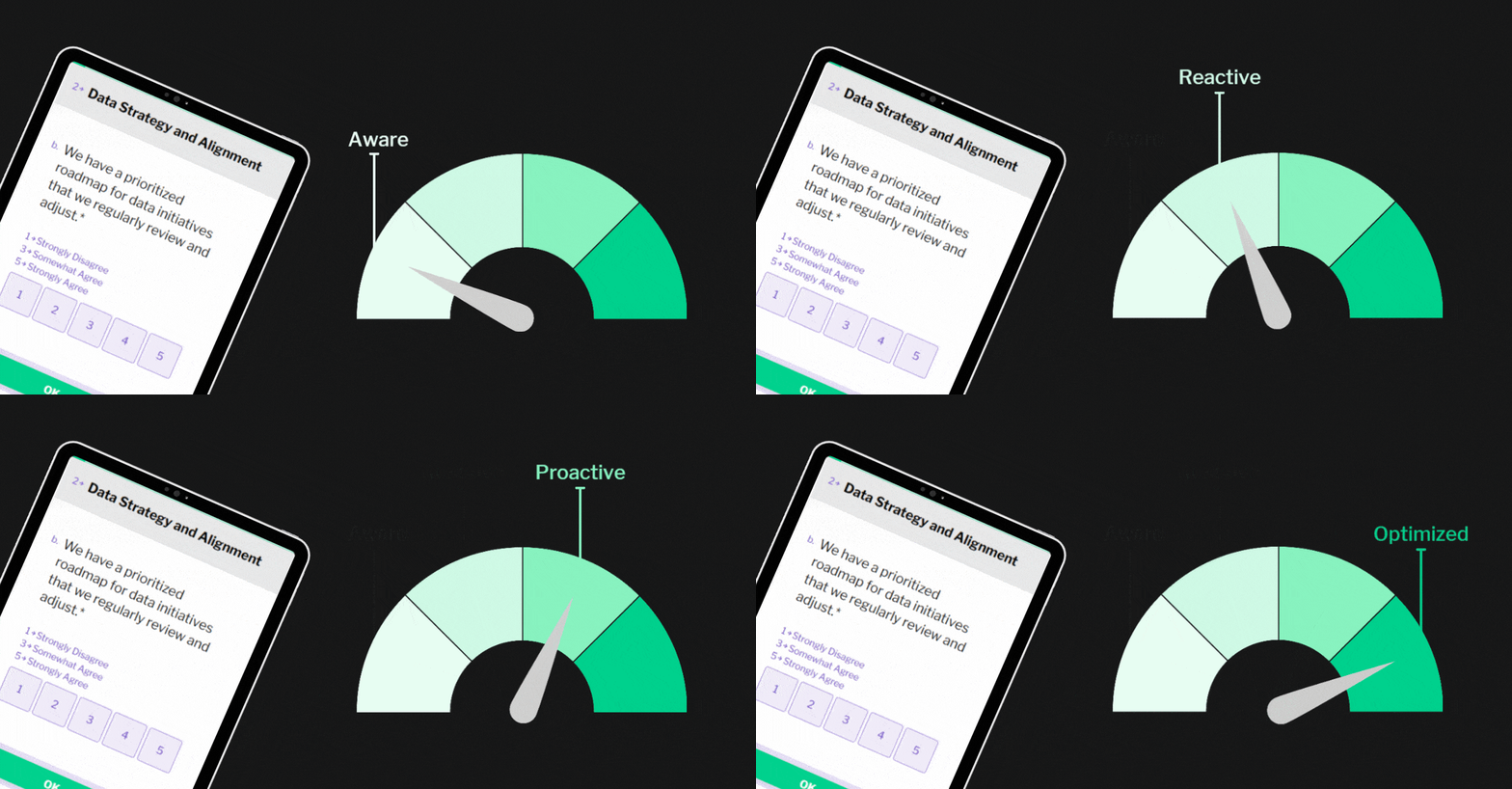
If you’re unsure where to begin, understanding your business’ current data and AI maturity level is a solid first step. Take our 5-minute assessment, and based on your results, you’ll get custom recommendations and next steps.

AI Activation in Private Equity: What Success Looks Like

AI Activation in Private Equity: What Success Looks Like

Written by

Jacob Zweig, Managing Director

Published

September 12, 2024

Data & AI Strategy
Portfolio AI Strategy
Financial Services

For private equity firms, artificial intelligence (AI) stands out as a game-changer, offering unprecedented opportunities for enhancing decision-making, optimizing operations, and driving value creation. AI success in a private equity firm involves a strategic approach that encompasses advanced analytics, robust AI operations, and impactful AI applications. Here’s a detailed look at what AI success looks like in this context.

Advanced Analytics and AI Fundamentals

Advanced analytics and AI have the potential to transform operations and drive significant value in portfolio companies.
Clearly Defined AI Strategy

Successful firms identify and define AI use cases that align with their business objectives and have the potential for significant impact. These use cases guide AI investments and development efforts.

Implementation of Predictive Models and ML Algorithms

AI success begins with the effective implementation of predictive models and machine learning (ML) algorithms in production environments. These tools can analyze vast amounts of data to predict future trends, identify investment opportunities, and mitigate risks.

In-House Data Science Expertise

Building a strong in-house team of data scientists, statisticians, and ML engineers is crucial. These experts drive AI initiatives, develop sophisticated models, and ensure the effective use of AI across the firm.

Experimentation with Advanced ML Techniques

Experimenting with and implementing advanced machine learning techniques, such as deep learning, enables the firm to tackle complex problems and discover new insights.

Maintaining a Feature Store

A feature store, which centralizes and standardizes features used in various models, is essential for efficient and consistent AI model development.

AI Operations and Infrastructure

To fully realize the benefits of AI, it’s essential to have robust operations and infrastructure in place.

Formal MLOps Framework

Adopting a formal MLOps framework is critical for managing the lifecycle of AI models, from development to deployment and monitoring. This framework ensures reliability, scalability, and continuous improvement of AI systems.

Monitoring Dashboards

Reliable monitoring dashboards are essential for tracking the health and performance of AI models in production. These tools provide real-time insights and enable proactive maintenance.

Integration with Operational Systems

Successful AI implementation extends beyond research projects, integrating AI models with operational systems, workflows, or core products to drive tangible business value.

Access to Data and Compute Resources

Providing data scientists with full access to necessary data sources and compute resources is crucial for maximizing AI model performance and innovation.

Versioning and Tracking

A robust process for versioning and tracking changes in AI models and datasets ensures transparency, reproducibility, and continuous improvement.

AI Applications and Use Cases

AI applications can provide substantial improvements in various business processes. Focus on practical use cases that drive operational efficiency and enhance customer experiences.

Computer Vision Applications

Implementing computer vision technologies, such as image recognition, object detection, and object tracking, can significantly enhance business processes and operational efficiency.

Natural Language Processing (NLP)

Utilizing NLP technologies for tasks like text classification, sentiment analysis, and chatbots enhances communication, customer service, and data analysis capabilities.

Large Language Models (LLMs)

Exploring and implementing large language models (LLMs) for various business applications can unlock new opportunities for automation and intelligence.

Supply Chain Optimization

AI-driven demand forecasting, inventory optimization, and other supply chain-related tasks enhance efficiency, reduce costs, and improve service levels.

AI-Driven Recommendation Systems

Implementing AI-driven recommendation systems enhances personalization and customer experience, driving higher engagement and conversion rates.

Assess Your Firm’s
Data and AI Maturity

If you’re unsure where to begin, understanding your business’ current data and AI maturity level is a solid first step. Take our 5-minute assessment, and based on your results, you’ll get custom recommendations and next steps.

Data Modernization in Private Equity: What Success Looks Like

Data Modernization in Private Equity: What Success Looks Like

Written by

Mike Galvin, Managing Director

Published

August 28, 2024

Data & AI Strategy
Portfolio AI Strategy
Financial Services

For private equity firms, leveraging data effectively can unlock new opportunities, enhance decision-making, and reduce investment risk. But data success is not just about having the latest tools and technologies; it’s about creating a holistic strategy that aligns with business objectives, managing infrastructure efficiently, and ensuring data accessibility and usability across the organization. In this blog, we dive into what data success looks like for private equity firms and their portfolio companies.

Data Strategy and Alignment

Having a clear and actionable data strategy is critical for aligning the interests of the PE firm and its portfolio companies.

1. Clearly Defined Data Strategy

Success starts with a well-defined data strategy that aligns with the firm’s overarching business objectives. This strategy should outline how data will be used to drive investment decisions, optimize portfolio performance, and create value.

2. Prioritized Roadmap for Data Initiatives

Having a prioritized roadmap for data initiatives is crucial. This roadmap should be regularly reviewed and adjusted to reflect changing business priorities and emerging opportunities.

3. Collaboration Between Business Units and IT

Strong collaboration between business units and IT is essential for driving the data strategy. This collaboration ensures that data initiatives are not only technically sound but also aligned with business needs.

4. Quantifiable Measures of Success

It’s important to have quantifiable measures of success for data initiatives. These metrics allow the firm to track progress, measure impact, and make informed decisions about future investments.

5. Understanding Critical Data

Not all data is created equal. Successful firms understand which data is critical for their competitive advantage and which is ancillary.

Data Infrastructure and Management

A solid data infrastructure is the backbone of any successful data strategy.

1. Centralized Data Location

Centralizing all data from various source systems into a single location, such as a data lake, is a key aspect of data success. This centralization simplifies data management and improves access.

2. Automated Data Cleaning and Standardization

Automated processes for data cleaning and standardization are essential for maintaining high-quality data. These processes reduce errors and ensure consistency.

3. Scalable Data Ingestion

Data ingestion processes must be scalable to handle changes in operational systems without impacting analytics. This scalability ensures that the firm can adapt to growth and new data sources seamlessly.

4. Leveraging Cloud Platforms

Utilizing cloud platforms like AWS, Azure, or Google Cloud for data infrastructure offers flexibility, scalability, and robust security.

5. High-Availability and Disaster Recovery

Ensuring high-availability and disaster recovery solutions for the data platform is crucial for maintaining business continuity and protecting valuable data assets.

Data Accessibility and Usability

Making data easily accessible and usable is crucial for enabling data-driven decision-making across portfolio companies.

1. Easy Access to Relevant Data

Business users across the organization should have easy access to relevant data in a central location. This accessibility empowers them to make data-driven decisions quickly and effectively.

2. Enterprise-Wide Reporting Tool

Using an enterprise-wide reporting tool to share data insights internally and externally enhances transparency and collaboration.

3. Consistent Data Security Measures

Consistently applying data security measures ensures appropriate levels of data visibility while protecting sensitive information.

4. Accessible Metrics for Decision-Making

Employees should have easy access to metrics that support data-driven decision-making in their daily work. This accessibility enhances operational efficiency and strategic planning.

5. Centralized Business Metrics Calculation

A single, centralized calculation for all business metrics ensures consistency and reliability in reporting and analysis.

Assess Your Firm’s
Data and AI Maturity

If you’re unsure where to begin, understanding your business’ current data and AI maturity level is a solid first step. Take our 5-minute assessment, and based on your results, you’ll get custom recommendations and next steps.

Transforming Private Equity: AI’s Role in Deal Sourcing, Value Creation, and Exits

Transforming Private Equity: AI’s Role in Deal Sourcing, Value Creation, and Exits

Data & AI Strategy
Portfolio AI Strategy
Financial Services

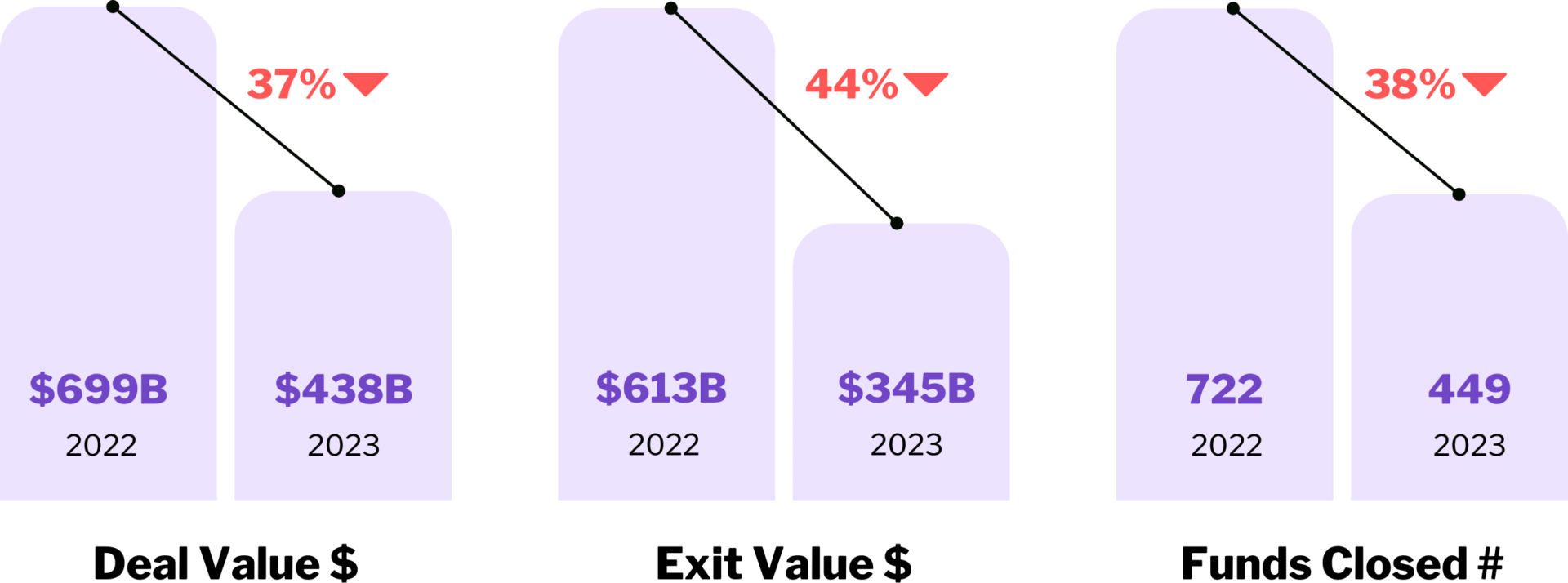
For private equity firms, the rapid rise in interest rates and heightened competition in 2023 has resulted in sharp declines in deal-making, exits, and fund-raising. According to Bain & Company’s 2024 Global Private Equity Report, these market conditions have led to a significant amount of capital sitting on the sidewalks, a high number of unexited assets, increased pressure to generate EBITDA, and investors are seeking “safer” investments.

To successfully navigate the current landscape of the PE industry, firms must excel in three critical areas: Deal Sourcing, Value Creation, and Exit Strategy. Leveraging Artificial Intelligence (AI) can help PE firms increase speed and efficiency across these three areas.

1. Deal Sourcing

Effective deal sourcing is the cornerstone of successful private equity operations. Traditionally, this process involves building robust networks with industry experts, brokers, and advisors to access lucrative deals at the earliest stages. However, with the advent of AI, this landscape is changing dramatically.

AI Use Cases for Deal Sourcing:

Unified Portfolio Analytics & Market Analysis

AI can scan vast amounts of data to identify potential opportunities, perform detailed due diligence, and develop accurate valuation strategies.

Targeted Outreach

AI-driven tools can generate personalized email drafts, ensuring that firms connect with the right contacts at the right time.

Deal Prioritization
  • AI helps prioritize deals based on strategic fit and potential ROI, reducing the risk of missing out on high-value opportunities.
Efficiency & Accuracy

The use of AI accelerates the deal sourcing process and increases the likelihood of identifying high-potential investments.

2. Value Creation

In private equity, rapidly improving EBITDA is crucial for driving growth and maximizing returns. AI plays a pivotal role in enhancing portfolio value creation by optimizing various operational aspects.

AI Use Cases for Value Creation:

Demand Forecasting

AI can predict future demand trends, enabling firms to make informed decisions on inventory, production, and resource allocation, ultimately driving revenue growth.

Customer Segmentation

By analyzing customer data, AI can identify distinct segments, allowing firms to tailor their strategies and offerings to meet the specific needs of different groups, enhancing customer satisfaction and loyalty.

Cost Reduction & Pricing Strategies

Advanced analytics powered by AI drive cost reduction initiatives and improve pricing strategies.

Uncovering Hidden Opportunities

AI analyzes unstructured data to provide insights into customer behavior, market dynamics, and operational performance, leading to innovative growth strategies.

3. Exit Strategy

A well-planned exit strategy is essential for realizing the full value of an investment. AI-driven insights elevate this process to new heights.

AI Use Cases for Exit Strategy:

Market Trends & Buyer Identification

AI analyzes market trends and identifies potential buyers, ensuring firms are well-prepared for exits.

Valuation Model Refinement

AI refines valuation models, providing more accurate and data-backed assessments.

Stakeholder Alignment & Smooth Transitions

NLP tools analyze communication patterns and stakeholder sentiment, aiding effective engagement and negotiation strategies.

Timing Optimization

Predictive analytics forecast industry trends and buyer behavior, helping firms time their exits for maximum return.

Streamlined Due Diligence

AI streamlines the due diligence process for potential buyers, making the firm’s exit offering more attractive.

Maximizing Portfolio Value
with Data & AI

The intersection of data and AI is continuing to shape the business landscape. For private equity firms, leveraging data and AI is a necessity for driving value creation and operational efficiency in portfolio companies. Check out our playbook that guides private equity firms and their portfolio companies through seven essential components of a robust data and AI strategy, helping achieve and maintain data maturity.

Written by

Jacob Zweig, Managing Director

Published

August 14, 2024