
Top 10 Data & AI Trends Private Equity Firms Should Watch in 2024

Top 10 Data & AI Trends Private Equity Firms Should Watch in 2024

Written by

Mike Galvin, Managing Director

Published

August 1, 2024

Data & AI Strategy
Portfolio AI Strategy
Financial Services

As we navigate through 2024, the landscape of data and artificial intelligence (AI) continues to evolve at a rapid pace. For private equity firms, staying ahead of these trends is crucial for making informed investment decisions, optimizing portfolio company performance, and driving value creation. Here are the top data and AI trends that private equity firms should keep an eye on this year.

1. Generative AI and Large Language Models (LLMs)

Generative AI and large language models, such as OpenAI’s GPT-4, are revolutionizing the way businesses operate. These models are capable of generating human-like text, which can be used in a variety of applications from content creation to customer service automation. According to a report by Gartner, the use of AI in content creation is expected to grow by 30% by 2024. Private equity firms can leverage these technologies to enhance marketing efforts, streamline communication processes, and improve decision-making through advanced data analysis.

Source: Gartner “Predictive Analytics Market Research Report”

2. AI-Driven Predictive Analytics

Predictive analytics has become a cornerstone for data-driven decision-making. With advancements in AI, predictive models are now more accurate and capable of processing vast amounts of data in real-time. According to McKinsey, companies that use predictive analytics report a 20-25% increase in their overall performance. Private equity firms can use AI-driven predictive analytics to forecast market trends, identify potential investment opportunities, and mitigate risks by anticipating financial downturns or market shifts.

Source: McKinsey & Company “The Value of Predictive Analytics”

3. Edge AI and IoT Integration

The integration of AI with Internet of Things (IoT) devices is creating new opportunities for data collection and analysis at the edge of networks. Edge AI allows for real-time processing of data on devices such as sensors and cameras, reducing latency and improving efficiency. IDC predicts that by 2025, 75% of enterprise-generated data will be created and processed at the edge. Private equity firms investing in industries like manufacturing, healthcare, and logistics should watch for advancements in edge AI to capitalize on improved operational efficiencies and innovative business models.

Source: IDC “Edge Computing and IoT Market Forecast”

4. AI Ethics and Governance

As AI becomes more pervasive, the need for robust ethics and governance frameworks is increasingly important. Regulatory bodies around the world are beginning to implement stricter guidelines to ensure AI is used responsibly and ethically. A PwC survey found that 85% of CEOs believe AI ethics and governance will be critical to gaining public trust. Private equity firms must prioritize investments in companies that adhere to ethical AI practices and have strong governance structures in place to avoid regulatory pitfalls and maintain public trust.

Source: PwC “AI Ethics and Governance Survey”

5. AI in Cybersecurity

Cybersecurity remains a top concern for businesses across all sectors. AI is playing a crucial role in enhancing cybersecurity measures by detecting threats in real-time, automating response actions, and predicting potential vulnerabilities. According to a report by Capgemini, 69% of organizations believe AI will be necessary to respond to cyber threats. Private equity firms should consider the cybersecurity capabilities of their portfolio companies and look for investment opportunities in AI-driven cybersecurity solutions to safeguard assets and data integrity.

Source: Capgemini “AI in Cybersecurity Report”

6. Sustainable AI and Green Technology

Sustainability is becoming a key focus area for investors and businesses alike. AI is being used to drive sustainable practices across various industries, from optimizing energy consumption to improving supply chain efficiencies. A study by Accenture found that AI has the potential to boost renewable energy efficiency by up to 20%. Private equity firms should monitor advancements in sustainable AI and green technologies, as these can offer both financial returns and positive environmental impact, aligning with the growing demand for ESG (Environmental, Social, and Governance) investments.

Source: Accenture (2023) “AI and Sustainability Report”

7. AI-Powered Automation and Workforce Transformation

Automation driven by AI is transforming the workforce landscape. From robotic process automation (RPA) to AI-driven customer service bots, businesses are increasingly adopting automation to enhance productivity and reduce costs. According to Deloitte, 58% of business leaders have implemented some form of AI automation, and this number is expected to grow. Private equity firms need to understand the implications of AI-powered automation on workforce dynamics and consider investing in companies that are leading the way in innovative workforce transformation.

Source: Deloitte “AI-Powered Automation Adoption Survey”

8. AI in Healthcare and Life Sciences

The healthcare and life sciences sectors are experiencing significant advancements due to AI. From drug discovery to personalized medicine, AI is enabling breakthroughs that were previously unimaginable. The AI in healthcare market is projected to reach $45.2 billion by 2026, growing at a CAGR of 44.9% from 2021. Private equity firms should keep a close watch on AI developments in these sectors, as they present lucrative investment opportunities with the potential to drive significant societal impact.

Source: MarketsandMarkets “AI in Healthcare Market Forecast”

9. Quantum Computing and AI

Quantum computing is still in its early stages, but its potential to revolutionize AI and data analytics is immense. Quantum computers can process complex calculations at unprecedented speeds, which could lead to breakthroughs in areas such as cryptography, material science, and large-scale data analysis. According to a report by Boston Consulting Group, the quantum computing market is expected to reach $850 billion by 2040. Private equity firms should stay informed about advancements in quantum computing and consider the long-term implications for AI and data strategies.

Source: Boston Consulting Group “Quantum Computing Market Analysis”

10. AI-Enhanced Customer Experience

Enhancing customer experience through AI is becoming a competitive differentiator for businesses. AI-powered chatbots, personalized recommendations, and predictive customer analytics are just a few examples of how AI is being used to improve customer satisfaction and loyalty. According to Salesforce, 57% of customers are willing to share personal data in exchange for personalized offers or discounts. Private equity firms should look for investment opportunities in companies that are leveraging AI to deliver superior customer experiences, as this can drive growth and profitability.

Source: Salesforce”State of the Connected Customer Report”

Maximizing Portfolio Value
with Data & AI

The intersection of data and AI is continuing to shape the business landscape. For private equity firms, leveraging data and AI is a necessity for driving value creation and operational efficiency in portfolio companies. Check out our playbook that guides private equity firms and their portfolio companies through seven essential components of a robust data and AI strategy, helping achieve and maintain data maturity.


Shifting Perspective on AI: From Cost to Strategic Investment

Shifting Perspective on AI: From Cost to Strategic Investment

Written by

Jacob Zweig, Managing Director

Published

July 23, 2024

Data & AI Strategy

Despite the transformative potential of Artificial Intelligence (AI), many organizations still view AI as a significant expense rather than a strategic investment. The perception of AI as a cost stems from various factors:

Initial Investment

The upfront costs of AI projects, including software, hardware, and skilled personnel, can be substantial. This often leads to sticker shock and a focus on short-term financial impacts.

Complexity and Uncertainty

AI initiatives can be complex and uncertain. The fear of failure and the unknowns associated with AI can make it challenging for leaders to justify the investment.

Lack of Immediate ROI

AI projects may not deliver immediate returns. The benefits of AI often manifest over time through increased efficiency, improved decision-making, and innovation, making it difficult for leaders to see the value upfront.

This misconception can hinder the adoption and successful implementation of AI initiatives, ultimately limiting the potential for long-term growth and competitive advantage. In fact, a recent survey by IDC revealed that businesses are experiencing an average 3.5x return on their AI investments, equating to a 250% ROI, highlighting the substantial value derived from AI initiatives (VentureBeat).

The Solution: Shifting Perspective from Cost to Investment

To fully harness the transformative power of AI, organizations must shift their perspective from viewing AI as a cost to recognizing it as a strategic investment. Here’s how they can achieve this shift:

1. Understand the Long-Term Benefits: AI can drive long-term growth by enabling better decision-making, enhancing customer experiences, and uncovering new business opportunities. By focusing on these long-term benefits, organizations can justify the initial investment.

2. Highlight Efficiency Gains: AI can automate routine tasks, reduce operational costs, and increase productivity. These efficiency gains can provide a significant return on investment over time.

3. Leverage Competitive Advantage: AI can provide a competitive edge by enabling organizations to innovate faster, personalize offerings, and respond more quickly to market changes. Viewing AI as a strategic tool can help organizations stay ahead of the competition.

4. Develop a Clear ROI Framework: Establishing a clear framework to measure the return on investment for AI projects can help leaders see the tangible benefits. This includes setting specific goals, tracking key performance indicators (KPIs), and regularly reviewing progress.

5. Invest in Talent and Skills: Building a skilled workforce is crucial for the successful implementation of AI. Investing in training and development can ensure that the organization has the necessary expertise to leverage AI effectively.

6. Adopt a Phased Approach: Rather than embarking on large-scale AI projects, organizations can start with smaller, pilot projects that demonstrate quick wins. This can help build confidence and support for larger investments.

Real-World Impact: How AI is Transforming Three Sectors

Artificial Intelligence (AI) is revolutionizing various industries by enhancing efficiency, driving innovation, and creating new business opportunities. Here are some key statistics and benefits across Healthcare, Finance, and Manufacturing.

Healthcare

AI in healthcare is improving patient outcomes and operational efficiency:

Diagnosis and Treatment

AI-powered tools can analyze medical images and patient data to assist in diagnosis and treatment planning. For instance, AI systems can detect early signs of diseases such as cancer with an accuracy rate of up to 95% (Journal of the American Medical Association).

Operational Efficiency

AI can streamline administrative tasks, reducing costs. McKinsey estimates that AI applications could save up to $150 billion annually in the U.S. healthcare system by 2026 (McKinsey & Company).

Finance

The financial industry leverages AI for fraud detection, customer service, and investment strategies:

Fraud Detection

AI algorithms can detect fraudulent activities by analyzing transaction patterns. The use of AI in fraud detection can reduce false positives by up to 50% and improve detection rates by up to 90% (The Financial Times).

Customer Service

Chatbots and AI-driven customer service platforms handle millions of inquiries efficiently. Juniper Research predicts that chatbots will save banks $7.3 billion globally by 2023 (Juniper Research).

Investment Strategies

AI-driven algorithms optimize investment portfolios, with robo-advisors managing assets expected to grow to $1.2 trillion by 2024 (Business Insider).

Manufacturing

AI in manufacturing is boosting productivity and reducing downtime:

Predictive Maintenance

AI-driven predictive maintenance can reduce equipment downtime by up to 50% and extend the life of machines by 20-40% (PwC).

Quality Control

AI systems can detect defects in products with up to 99% accuracy, significantly improving quality control processes (Deloitte).

Embracing AI as a Strategic Investment

Viewing AI as a strategic investment rather than a cost is crucial for organizations aiming to thrive in the digital age. By understanding the long-term benefits, highlighting efficiency gains, leveraging competitive advantage, and adopting a phased approach, organizations can harness the transformative power of AI. Investing in AI today can drive sustainable growth, innovation, and competitive advantage for years to come. The future belongs to those who see beyond the initial costs and recognize the strategic value that AI can bring to their organizations.


The impact outweighs the investment.

Embrace AI now and position your organization as a leader in the digital age. Get in touch with us to learn how we can help you embark on your AI journey and capture transformative business value.

Contact Us

Laying the Groundwork for AI: Establishing a Data-Driven Culture

Laying the Groundwork for AI: Establishing a Data-Driven Culture

Written by

Mike Galvin, Managing Director

Published

July 11, 2024

Data & AI Strategy

A recent Deloitte survey revealed that 51% of CEOs consider data challenges the primary obstacle to generating business value with Artificial Intelligence (AI), highlighting the critical importance of data readiness in AI implementation.

AI’s power lies in its ability to analyze vast amounts of data and derive actionable insights. However, this process hinges on the quality and integration of the data fed into AI systems. Poor data quality, fragmented data sources, and a lack of integration between systems can significantly hamper the effectiveness of AI initiatives. Let’s delve into these challenges and explore how building a data-driven culture can serve as a solution.

1. Poor Data Quality: AI systems rely on high-quality data to function effectively. Data quality issues, such as inaccuracies, inconsistencies, and missing values, can lead to erroneous insights and decisions. Poor data quality can stem from various sources, including human error, outdated information, and inadequate data governance practices.

2. Fragmented Data Sources: In many organizations, data is scattered across multiple systems, departments, and formats. This fragmentation creates silos that hinder the comprehensive analysis needed for AI to be effective. Fragmented data sources result in a lack of a unified view, making it difficult to draw meaningful conclusions.

3. Lack of Integration Between Systems: Integration issues arise when disparate systems and technologies cannot seamlessly communicate and share data. This lack of integration prevents the smooth flow of information, leading to inefficiencies and missed opportunities. Incompatible data formats, legacy systems, and insufficient interoperability are common culprits.

In a recent Deep Dish Data panel, best-selling author Joe Reis shares:

How often do you find that data is ready for any particular use case or consumption? Most datasets are really gnarly. We need to focus on establishing the foundation and getting the fundamentals in place.

Laying the Foundation for a Data-Driven Culture

Creating a data-driven culture involves more than just deploying advanced technologies; it requires a holistic approach to managing data effectively. By focusing on the key areas below, organizations can transform their data into a valuable asset that drives informed decision-making and competitive advantage.

1. Establishing Data Governance

Effective data governance is the cornerstone of high-quality data. Implementing robust data governance policies ensures data accuracy, consistency, and reliability. This involves defining data standards, establishing data ownership, and implementing processes for data validation and cleansing.

2. Centralizing Data Management

To combat fragmented data sources, organizations should centralize data management. This can be achieved through data warehouses, data lakes, or cloud-based platforms that consolidate data from various sources. Centralized data management provides a unified view, enabling comprehensive analysis and facilitating better decision-making.

3. Enhancing Data Integration

Integrating data across systems requires the adoption of modern data integration tools and technologies. Application Programming Interfaces (APIs), middleware, and data integration platforms can facilitate seamless data exchange between systems. Emphasizing interoperability and adopting industry standards can further streamline integration efforts.

4. Promoting Data Literacy

Building a data-driven culture goes beyond technology and processes—it involves people. Promoting data literacy across the organization empowers employees to understand, interpret, and leverage data effectively. Training programs, workshops, and fostering a culture of continuous learning are key to enhancing data literacy.

5. Leveraging AI for Data Quality

AI itself can be harnessed to improve data quality. Joe Reis points out: “If the approaches to data management and governance that we’ve taken for the last several decades are having mixed results, will AI be a hail mary to make it work? I’m willing to take the bet that maybe this is worth considering.” Machine learning algorithms can detect anomalies, automate data cleansing, and validate data entries. By leveraging AI for data quality management, organizations can ensure that their data is accurate, consistent, and reliable.

Breaking Down Data Silos: A Success Story

How a Private Equity firm unified data for enhanced portfolio insights and reduced risk​

Our client, a private equity firm managing a diverse portfolio of investments, faced challenges in leveraging data for strategic decision-making. The firm needed a modern data infrastructure to consolidate disparate datasets, enhance analytical capabilities, and gain deeper insights into overall portfolio performance.

The implementation of a comprehensive data infrastructure provided the private equity firm with a holistic view of portfolio performance while ensuring data security and integrity. This empowered the firm to make more informed decisions, enhance operational efficiency, and gain deeper insights into their investments, ultimately mitigating risks and fostering long-term profitability.

Pro Tip: Start Small with Rule-Based Systems

As Winston Churchill famously said, “perfection is the enemy of progress.” While it’s important to focus on the above holistic approach to AI-ready data, you don’t necessarily need to wait until you reach the finish line before you can get started with AI. There’s a common misconception that you need enormous volumes of data to get started. But it’s not true. The reality is that you can start small and still make significant strides. 

One approach is to begin with rule-based systems. These systems use predefined rules to process data and make decisions, providing immediate value without the need for massive datasets. Think of it as laying a solid foundation upon which you can build more sophisticated machine learning models over time. Starting with rule-based systems allows you to:

1. Gain Initial Insights: Even with limited data, rule-based systems can uncover valuable patterns and trends.

2. Improve Gradually: As you collect more data, you can refine and enhance your models, gradually transitioning to more advanced machine learning solutions.

3. Mitigate Risks: By starting small, you can test and validate your AI strategies without the risk of over-investing in unproven approaches.

The key to successful AI and ML outcomes isn’t the volume of your data—it’s how effectively you use the data you have.

Transforming Data into a Valuable Asset

Overcoming data quality and integration challenges is not merely a technical endeavor—it is a strategic initiative that transforms data into a valuable asset. By building a data-driven culture, organizations can unlock the full potential of their AI investments. High-quality, integrated data serves as the foundation for AI to deliver accurate insights, drive innovation, and create a competitive advantage.

By establishing robust data governance, centralizing data management, enhancing data integration, promoting data literacy, and  leveraging AI for data quality, organizations can overcome these challenges. Embracing a data-driven culture is not just a solution—it is the key to transforming data into a powerful asset that propels AI effectiveness and drives business outcomes.

It starts with a solid data foundation.

Embrace AI now and position your organization as a leader in the digital age. Get in touch with us to learn how we can help you embark on your AI journey and capture transformative business value.

Contact Us

From AI Confusion to Clarity: Overcoming the Uncertainty of Where to Start

From AI Confusion to Clarity: Overcoming the Uncertainty of Where to Start

Written by

Jacob Zweig, Managing Director

Published

July 3, 2024

Data & AI Strategy

Artificial Intelligence (AI) holds incredible promise for revolutionizing industries and unlocking new business value. However, many companies find themselves at a crossroads when it comes to initiating their AI journey. The one of the biggest pain points? Confusion on where to start. According to a recent Deloitte survey, 55% of CEOs state the identification of the right use cases as the primary obstacle to realizing AI’s business value.

Beyond Algorithms: Identifying
Transformative AI Use Cases

If your business doesn’t have at least three AI use cases delivering significant value by the end of 2024, you’re falling behind. Most companies initially perceive AI implementation as a technology challenge. They think the key lies in acquiring the latest algorithms, software, or hardware. However, the real challenge is not in the technology itself but in identifying compelling AI use cases that can genuinely transform their business.

To leverage AI effectively, companies must shift their mindset. The most impactful AI use cases are not just incremental improvements to existing processes. They often require a fundamental rethinking of how the business operates, including redesigning business processes, understanding the human experience, and effectively managing change to ensure adoption. Addressing ethical and privacy concerns is also essential for responsible AI implementation. Without this capability, even the most advanced AI technologies can fail to deliver substantial value.

5 Steps to Get You from Zero to AI

By following a structured approach, your organization can navigate the complexities of AI implementation and unlock its transformative potential. Here’s a step-by-step guide to help your organization get from zero to AI, ensuring you address critical cultural and organizational challenges, identify high-impact use cases, and scale AI solutions effectively.

Step 1: Start Now, Don’t Wait

The journey to AI success begins with a single step: start now. Waiting for the perfect moment or the ideal technology setup can lead to missed opportunities. Begin by fostering a culture of innovation and openness to AI within your organization. Addressing cultural and organizational challenges is crucial. In a recent LinkedIn post, Ryan Litvak, Director of Data and Analytics at Jabil, explains: 

Businesses often face cultural and organizational challenges. AI needs a lot of good data, and if a company still relies on manual processes or just wants to use AI to automate those processes without rethinking their business model, success will be hard to come by. Plus, if systems aren’t connected and can’t share data easily, AI projects won’t get off the ground. It’s crucial to build a data-driven culture and ensure your systems work well together to unlock AI’s full potential.

Step 2: Identify High-Impact Use Cases

Look for areas where AI can make a significant difference. These use cases should have the potential to transform your operations, improve efficiency, enhance customer experience, or open new revenue streams. The key is to think big and envision how AI can fundamentally change the way you do business. Making ideas happen with incisive strategy and a bias toward action is crucial. In a recent LinkedIn post, Sean Eidson, CEO of Merit Golf, shares a helpful tip:

Give yourself a constraint framework. Ask, “How might we?”

“How might we create 10x the versions of the email with the same creative budget?”

“How might we review 10x the applications (loan applications, job applications, content submissions) with the same budget?”

Step 3: Pilot Projects

Implementing pilot projects is a practical way to start. Select a few high-priority use cases and develop pilot projects around them. These pilots will help you test the feasibility and impact of AI solutions on a smaller scale before scaling them up. Ensure that these projects address your specific needs and deliver measurable outcomes.

Step 4: Learn and Iterate

AI implementation is an iterative process. Learn from your pilot projects, gather feedback, and refine your approach. This iterative cycle will help you build the expertise and confidence needed to scale AI initiatives across your organization.

Step 5: Scale and Integrate

Once you have successfully implemented and refined your pilot projects, it’s time to scale them up. Integrate AI solutions into your broader business processes and continuously monitor their performance. The insights gained from initial projects will guide you in expanding AI’s impact throughout your organization.

Embark on Your AI Journey with Confidence

Embarking on an AI journey can be daunting, but you don’t have to do it alone. OneSix’s expertise in identifying and implementing high-impact AI use cases can help you navigate this complex landscape. We design, build, and deploy custom AI solutions that address your specific needs, ensuring you see tangible results and business value from your AI initiatives. Let’s take the first step together, transforming confusion into clarity and making AI a driving force for your business success.

The best thing you can do is start now.

Embrace AI now and position your organization as a leader in the digital age. Get in touch with us to learn how we can help you embark on your AI journey and capture transformative business value.

Contact Us

Embracing AI: Why the Wait-and-See Approach Could Leave Your Business Behind

Embracing AI: Why the Wait-and-See Approach Could Leave Your Business Behind

Written by

Jacob Zweig, Managing Director

Published

June 25, 2024

Data & AI Strategy

The “wait-and-see” approach, especially concerning the adoption of Artificial Intelligence (AI), might seem prudent at first glance. After all, waiting for competitors to navigate the uncharted waters of AI can appear to mitigate risks. However, this strategy can also lead to significant missed opportunities and leave your organization trailing behind competitors.

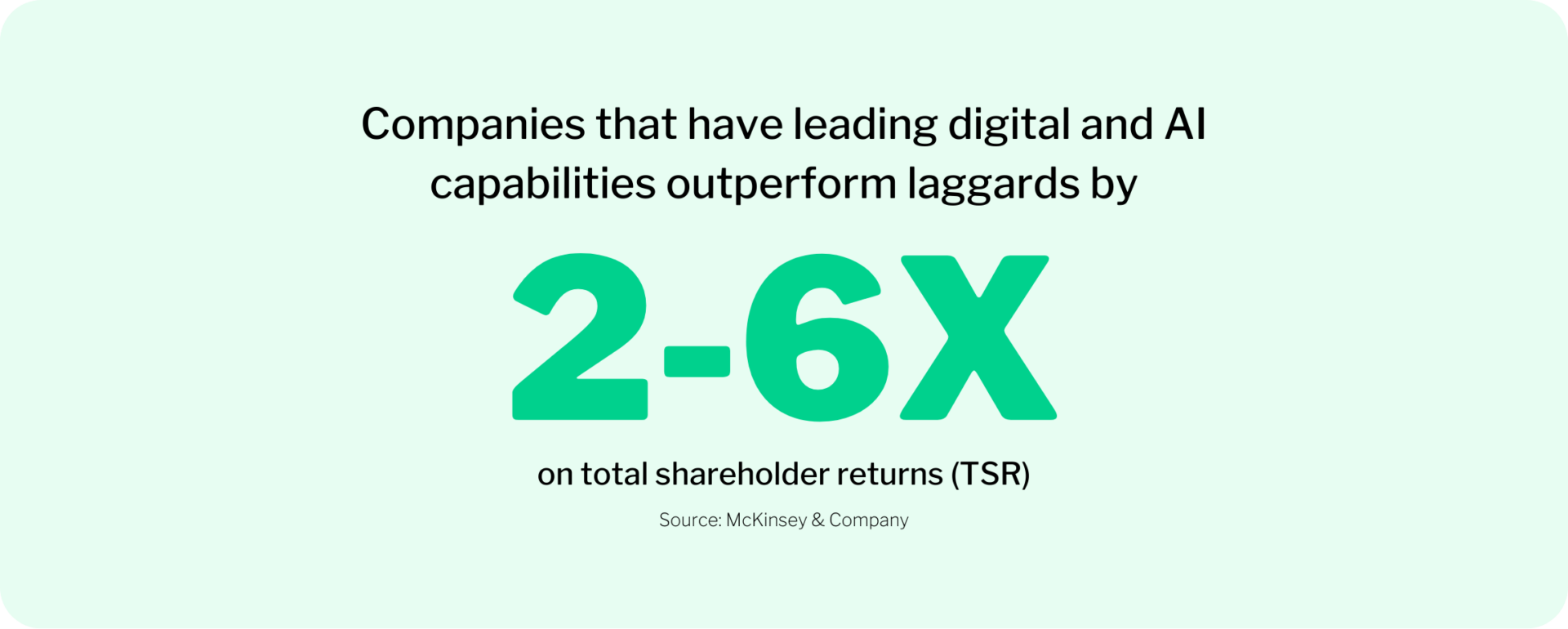
The business value of embracing AI is real and significant—which means the cost of not embracing AI is just as significant. According to McKinsey research, “companies that have leading digital and AI capabilities outperform laggards by two to six times on total shareholder returns (TSR) across every sector analyzed.” So, the question becomes: can your business afford to continue to wait-and-see?

The Downside of the Wait-and-See Approach

The hesitation in implementing AI solutions often stems from a fear of the unknown. Leaders worry about the cost, the complexity, and the potential for failure. They prefer to observe how competitors fare before committing their own resources. While understandable, this cautious stance can have several detrimental effects:

Missed Opportunities

AI and data-driven insights can uncover opportunities for innovation, efficiency, and improved customer experiences. By waiting, businesses miss out on these potential benefits, allowing competitors to seize market share and establish themselves as leaders.

Lagging Behind Competitors

Early adopters of AI are often seen as industry pioneers. They set new standards and expectations that latecomers must follow. Playing catch-up can be costly and time-consuming, and businesses might find themselves perpetually behind the curve.

Diminished Market Relevance

As more industries embrace AI, customers begin to expect smarter, more personalized experiences. Companies that lag in AI adoption may struggle to meet these evolving expectations, leading to a decline in customer satisfaction and loyalty.

Overcoming AI Reluctance: A Success Story

How a Pharma Company Increased Provider Engagement through AI-Powered Automation

OneSix collaborated with a top 5 global pharmaceutical company to build and deploy an artificially intelligent multi-channel promotional outreach engine across multiple strategic brand portfolios. Previously, the company’s manual engagement processes and focus on aggregate customer segments led to inefficiencies and missed opportunities for personalized interaction.


The goal was to create an integrated, AI-driven marketing strategy that predicted and influenced individual provider engagement. Using Strong RL, Apache Spark, and TensorFlow, the custom solution automated engagement across multiple brands and channels, leveraging individual provider data to optimize interactions.


Evolving from an AI Laggard to a Leader

Adopting AI doesn’t have to be a daunting, drawn-out process. With the right partner, your organization can transition from zero to AI leadership swiftly and effectively. Here’s how OneSix, a leading data and AI consultancy, can help:

Proven Expertise

We have a track record of successfully implementing AI solutions for leading organizations across various industries. Our experience ensures that we understand the unique challenges and opportunities in your sector, allowing us to tailor AI strategies that drive real business value.

Holistic Partnership

From initial strategy development to deployment and ongoing support, we provide end-to-end services that cover every aspect of AI implementation. Our approach minimizes risks and maximizes the value of your investment.

Accelerated Implementation

Time is of the essence. We utilize agile methodologies and advanced tools to accelerate the deployment process, ensuring that you can start reaping the benefits of AI quickly.

Focus on ROI

We prioritize solutions that deliver tangible business outcomes. By aligning AI initiatives with your strategic goals, we ensure that every project contributes to your bottom line. Whether it’s improving operational efficiency, enhancing customer experiences, or driving innovation, our focus is on generating a strong return on investment.

Staying Ahead of the Curve

The AI landscape is continually evolving. We stay at the forefront of these changes, incorporating the latest advancements into our solutions. This commitment to innovation ensures that your organization remains competitive and can leverage new opportunities as they arise.

In the world of AI, hesitation can be costly. The wait-and-see approach might seem safe, but in reality, it often leads to missed opportunities and a reactive stance that leaves your organization perpetually behind. By partnering with OneSix, you can transition from hesitancy to leadership, harnessing the full power of AI to drive your business forward.

Don’t let your competitors set the pace.

Embrace AI now and position your organization as a leader in the digital age. Get in touch with us to learn how we can help you embark on your AI journey and capture transformative business value.

Contact Us

Getting Your Data AI-Ready: Deep Dish Data Recording

Getting Your Data AI-Ready: Deep Dish Data Recording

Written by

Mike Galvin, CEO & Co-Founder

Published

April 25, 2024

Data & AI Strategy
Matillion

This month, Matillion’s Deep Dish Data virtual series broadcasted live from the OneSix office in Chicago, the home of deep-dish and data experts. We had a fantastic time engaging with attendees and delving into insightful discussions about preparing data for the AI revolution. Throughout the virtual broadcast from Chicago, we had the pleasure of engaging in meaningful discussions led by industry experts like CEO of OneSix Mike Galvin, best-selling author Joe Reis, and leaders from Matillion, Mark Balkenende and Molly Sandbo.

It’s easy to get swept up in the excitement of the latest buzzword: artificial intelligence (AI). But before diving headfirst into the realm of AI, it’s crucial to ensure that your data is AI-ready. This requires going back to basics and laying a solid foundation in data management.

In a recent panel discussion on getting data AI-ready, the conversation veered towards the fundamentals of data management, particularly data modeling. Joe, an expert with decades of experience in the field, highlighted the importance of understanding the basics of data modeling, lamenting that it’s often overlooked, especially among younger data engineers.

The discussion underscored the fact that most datasets are far from ready for any particular use case or consumption. The reality is that many datasets are messy and lack the necessary structure for effective analysis. To truly harness the power of AI, it’s essential to establish a strong foundation in data management practices like data modeling.

Mike shared a data horror story involving the use of name-value pairs in data, which led to inconsistencies and challenges in data analysis and reporting. This example served as a reminder of the importance of structured data and proper modeling techniques.

The conversation then turned to the influx of unstructured data, such as video, images, and text, and the challenges it presents. While some organizations are eager to leverage unstructured data for insights, many struggle to even understand the possibilities, let alone how to manage and analyze this data effectively.

Molly highlighted some common use cases for unstructured data, including customer support tickets and data classification. She emphasized the importance of automating processes and extracting valuable insights from unstructured data sources.

However, with the advent of generative AI and advanced technologies, the line between what’s possible and what’s practical becomes blurred. As Joe pointed out, easier access to AI capabilities doesn’t eliminate the need for careful consideration and domain expertise.

The panelists also discussed the challenges of trusting AI-driven insights, especially when the underlying data quality is questionable. Despite advancements in AI technology, many organizations still lack confidence in the reliability of their data.

Ultimately, the conversation emphasized the need to balance technological innovation with a deep understanding of data fundamentals. Before embracing AI, organizations must ensure that their data is well-managed, structured, and reliable. Only then can they fully harness the power of AI to drive meaningful insights and business outcomes.

In conclusion, getting your data AI-ready requires more than just deploying the latest AI tools and technologies. It demands a commitment to foundational data management principles and a thorough understanding of your data’s strengths, weaknesses, and potential biases. By prioritizing data quality and investing in robust data management practices, organizations can unlock the true potential of AI and drive innovation in the digital age.

Take the next step in your AI journey.

AI is not just a buzzword – it’s a catalyst for innovation, growth, and competitive advantage. So, how do you get started with leveraging AI to create business value? Join us for an AI Workshop to gain a comprehensive understanding of the AI ecosystem, delve into enterprise chatbot architecture, and identify industry-specific use cases for integrating AI seamlessly into your business operations.

Contact Us

Assessing Data Maturity in Private Equity: From Data Dabblers to AI Advocates

Assessing Data Maturity in Private Equity: From Data Dabblers to AI Advocates

Written by

Mike Galvin, CEO & Co-Founder

Published

April 18, 2024

Data & AI Strategy
Portfolio AI Strategy
Financial Services

Private equity firms are increasingly recognizing the importance of leveraging data to drive portfolio insights and mitigate investment risks. The journey towards data maturity in the private equity sector is not just about adopting the latest technologies; it’s about strategically navigating through various stages, each unlocking new opportunities for growth and innovation.

Whether your firm is just beginning its data integration journey or poised for advanced analytics adoption, understanding your current state is vital for crafting tailored strategies aligned with your organizational goals. Take our data maturity assessment to understand where your firm stands today and what you need to do to get to the next level.

Stage 1: Data Dabbler

At the initial stage of the journey, private equity firms are akin to data dabblers, just dipping their toes into the vast ocean of data possibilities. For portfolio companies, this stage involves implementing basic data management platforms to centralize data, conducting quality audits, and investing in analytics training. Establishing a data governance committee ensures alignment across departments and compliance with regulations like GDPR and CCPA.

For the private equity firm itself, adopting advanced analytics platforms for portfolio-wide performance tracking is essential. Standardizing data collection processes and investing in data-centric training for staff set the groundwork for future advancements.

Stage 2: Analytics Apprentice

As firms progress to the Analytics Apprentice stage, they delve deeper into data-driven decision-making. Portfolio companies implement advanced analytics platforms and establish protocols for data-driven decision-making. Automation becomes a key focus, optimizing repetitive tasks and workflows through data insights.

Within the private equity firm, aligning data strategy with business objectives and effectively communicating it across the organization is crucial. Leveraging data talent effectively and addressing resistance to change are vital for successful advancement to the next stage.

Stage 3: Centralization Champion

In the Centralization Champion stage, the focus shifts towards centralizing data and ensuring interoperability across systems. Portfolio companies adopt data integration platforms and invest in interoperable technologies to bridge legacy and modern systems. Data standardization initiatives ensure consistency across all sources.

For the private equity firm, robust data aggregation processes and quality assurance measures become paramount. Providing resources and support for portfolio companies to navigate regulatory compliance requirements is essential for success.

Stage 4: AI Advocate

At the pinnacle of the journey lies the AI Advocate stage, where firms fully embrace the power of artificial intelligence. Portfolio companies invest in AI-ready infrastructure and implement data labeling processes to ensure high-quality training data. Training programs and incentives attract and retain AI talent within the organization.

For the private equity firm, developing a comprehensive AI strategy aligned with business objectives is critical. Robust data governance frameworks ensure ethical and responsible AI use, fostering a culture of innovation and continuous improvement.

Your journey starts with a data maturity assessment.

Navigating the path towards data centralization can be daunting, especially for private equity firms facing diverse challenges in managing their data effectively. If you’re unsure where to begin, understanding your firm’s current data maturity level is the crucial first step. Complete the 8-question assessment and immediately get your firm’s data maturity score and ranking, along with recommendations for how to get to the next level.

Take the Assessment

The Power of Data Centralization for PE Firms and Their Portfolio Companies

The Power of Data Centralization for PE Firms and Their Portfolio Companies

Written by

Mike Galvin, CEO & Co-Founder

Published

March 27, 2024

Data & AI Strategy
Portfolio AI Strategy
Financial Services

In Private Equity (PE), data has emerged as a pivotal force reshaping the industry’s dynamics. From fragmented data sources to challenges in ensuring accuracy and accessibility, private equity firms and their portfolio companies grapple with a myriad of obstacles in leveraging data effectively. However, amidst these challenges lies a transformative solution: data centralization.

Transitioning from disparate data sources to a centralized repository offers private equity firms and their portfolio companies a host of compelling advantages. By consolidating data into unified platforms, firms can unlock new opportunities for streamlining operations, enhancing decision-making processes, and ultimately reducing investment risk.

Improved Data Accessibility and Integration

Centralizing data enables private equity firms to aggregate information from various portfolio companies into a unified repository, simplifying access for stakeholders. This consolidation streamlines integration with external sources, enriching analytical insights and supporting more informed decision-making.

Enhanced Data Quality and Consistency

Centralized data management allows firms to implement standardized processes, ensuring data quality and consistency across the organization. This commitment to data integrity enhances portfolio visibility, empowering stakeholders to assess performance metrics, track key indicators, and optimize portfolio allocation strategies.

Streamlined Reporting and Analysis

Centralized data facilitates standardized reporting and analysis, enabling firms to generate customized dashboards and financial analyses efficiently. Leveraging advanced analytics tools and real-time insights accelerates decision-making processes, enhancing responsiveness to market dynamics.

Collaboration and Knowledge Sharing

Centralized data repositories serve as hubs for collaboration and knowledge sharing, fostering a culture of innovation and value creation. By providing a single source of truth for data-driven insights, firms promote cross-functional alignment and exchange of best practices, ultimately enhancing organizational agility and competitiveness.

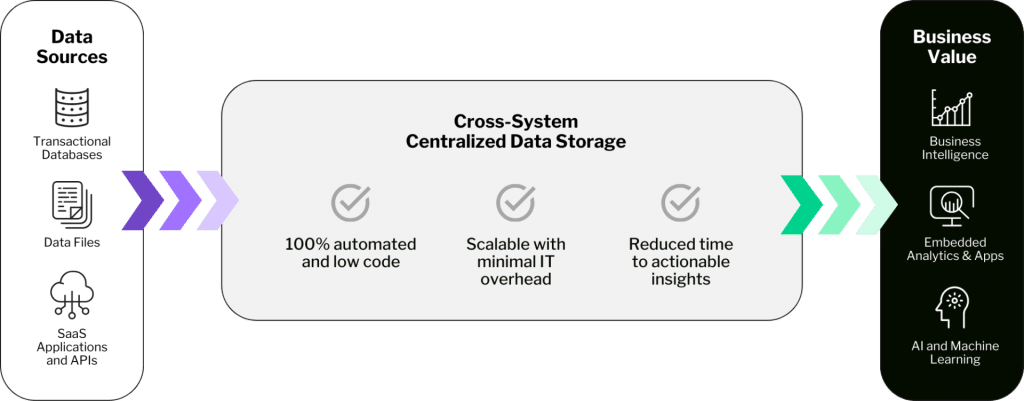
A modern data architecture is essential for centralizing data and gaining deeper insights into overall portfolio performance. OneSix implements the infrastructure and industry-leading tools to ingest data from business applications into a single source of truth. With this approach, we can create a system that solves the needs of each portfolio company, while addressing the challenges at the PE firm level.

Your Journey Starts with a Data Maturity Assessment

Navigating the path towards data centralization can be daunting, especially for private equity firms facing diverse challenges in managing their data effectively. If you’re unsure where to begin, understanding your firm’s current data maturity level is the crucial first step.

Complete the 8-question assessment and immediately get your firm’s data maturity score and ranking, along with recommendations for how to get to the next level.

Get Started

OneSix helps companies build the strategy, technology, and teams they need to unlock the power of their data.

AI in Action: Use Cases for Private Equity Firms

AI in Action: Use Cases for Private Equity Firms

Written by

Ross Knutson, Manager

Published

March 12, 2024

Data & AI Strategy
Portfolio AI Strategy
Financial Services
Private equity firms and their portfolio companies are increasingly leveraging artificial intelligence (AI) to gain competitive advantages, streamline processes, and make data-driven decisions. However, findings from a recent Deloitte survey highlight that 55% of CEOs state the identification of suitable use cases as the primary obstacle to realizing AI’s business value.

At OneSix, we believe that use cases must be both immediate and practical. While the potential list is long, we like to start with use cases that advance the organization and provide value within a 6-month time period—and lay a foundation that can be built upon.

Investment Strategy and Risk Management

Trends & Investment Monitoring

Private equity firms can develop custom AI models to predict market trends and assess investment risks effectively. By analyzing vast amounts of financial data and market indicators, AI algorithms can provide valuable insights into potential investment opportunities and risks. Additionally, full-stack AI applications can offer real-time portfolio management capabilities, enabling proactive decision-making and portfolio adjustments.

Unstructured Document Analysis

AI technologies can streamline due diligence processes by extracting key insights from unstructured data sources such as legal documents, market reports, and industry analyses. Advanced natural language processing (NLP) algorithms can sift through large volumes of text, identifying critical information relevant to investment evaluations without requiring extensive machine learning expertise. This streamlining enhances the efficiency and accuracy of due diligence procedures.

Exit Planning

Through comprehensive analysis of market trends, potential buyers, and valuation models, AI-driven insights guide decision-making processes towards maximizing the value of portfolio exits. By utilizing AI algorithms to identify emerging market opportunities, predict buyer behaviors, and assess competitive landscapes, private equity firms can formulate tailored exit strategies that align with overarching investment objectives.

Target Outreach and Analysis

Prospective Target Outreach

Private equity firms can employ AI to streamline outreach efforts to prospective target companies. By generating personalized email drafts using data scraped from public websites and databases, AI algorithms can assist in crafting tailored introductory communications. This automation not only saves time but also ensures that outreach messages are more targeted and impactful.

Prospective Target Analysis

AI-powered language models (LLMs) can gather and summarize public information about prospective target companies from various sources, including press releases, customer reviews, and news articles. By analyzing and synthesizing vast amounts of textual data, LLMs enable private equity firms to gain comprehensive insights into potential investment opportunities quickly and efficiently.

Portfolio Management and Innovation

Portfolio Company Innovations

Within portfolio companies, AI can drive innovation and value creation across various domains. Private equity firms can leverage traditional machine learning techniques for tasks such as demand forecasting, customer segmentation, and operational optimization. Additionally, integrating LLMs into portfolio companies can enable the development of custom chatbots, personalized customer experiences, and advanced analytics solutions, enhancing operational efficiency and competitive positioning.

Investor Profile Summarization

AI technologies, particularly LLMs, can assist private equity firms in summarizing key information about investor relationships. By analyzing communication logs, investment histories, and other relevant data sources, LLMs can generate concise summaries of investor profiles, recent interactions, and investment preferences. This automation reduces manual data entry efforts, enabling private equity professionals to focus more on building and nurturing investor relationships effectively.

Fraud Detection and Security

AI-powered Fraud Prevention Systems

Utilizing machine learning and cognitive capabilities, AI identifies patterns associated with fraud, preventing financial losses for banks. These systems can detect anomalies, identify potential threats, and take preemptive measures to secure financial transactions.

Enhancing Cybersecurity Measures

AI enhances cybersecurity in banking by continuously monitoring and analyzing vast amounts of data for potential security breaches. The proactive identification of threats helps banks fortify their cybersecurity measures, safeguarding customer data and maintaining trust.

Protecting Customer Data and Privacy

Through AI, banks implement robust data protection measures, ensuring compliance with privacy regulations. AI-driven solutions are adept at identifying and mitigating risks associated with data breaches, thereby safeguarding customer information.

Maximizing portfolio value with AI

For private equity (PE) firms and their portfolio companies, AI signals a new era of efficiency, insight, and competitive edge. Its ability to analyze vast datasets, predict market trends, and optimize decision-making processes propels PE professionals towards more informed and strategic outcomes, driving innovation and growth. For a deeper dive into how PE firms can leverage AI to create substantial business value, view our comprehensive guide.

Get the Guide

AI in Action: Use Cases for Banking Institutions

AI in Action: Use Cases for Banking Institutions

Written by

Ross Knutson, Manager

Published

February 22, 2024

Data & AI Strategy
Financial Services

Artificial Intelligence (AI) has emerged as a transformative force in the banking sector, revolutionizing various departments and processes. From enhancing customer experiences to streamlining operations, banks are leveraging AI across multiple dimensions.

However, findings from a recent Deloitte survey highlight that 55% of CEOs state the identification of suitable use cases as the primary obstacle to realizing AI’s business value.

At OneSix, we believe that use cases must be both immediate and practical. While the potential list is long, we like to start with use cases that advance the organization and provide value within a 6-month time period—and lay a foundation that can be built upon.

Operational Efficiency Gains

Automation of Routine Tasks

AI plays a crucial role in automating mundane and repetitive tasks within banking operations. This includes tasks like data entry, document verification, and transaction processing. Automation not only reduces human error but also significantly accelerates the speed at which these tasks are performed.

Streamlining Internal Processes

Through advanced algorithms, AI optimizes internal processes, making them more efficient and seamless. This streamlining extends to back-office operations, compliance checks, and workflow management. The result is a more agile and responsive banking infrastructure.

Cost Reduction and Resource Optimization

The implementation of AI leads to cost reduction by automating processes and minimizing resource requirements. By automating routine tasks, banks can allocate resources more strategically, focusing on high-value activities that require human expertise.

Enhancing Customer Experience

Personalized Services and Recommendations

AI analyzes customer behavior and interactions to provide personalized financial products and services. This level of customization enhances customer satisfaction, fosters loyalty, and strengthens the overall relationship between banks and their customers.

Chatbots and Virtual Assistants

Implementing AI-driven chatbots and virtual assistants improves customer engagement by providing instant and accurate responses to inquiries. These intelligent systems not only save time but also contribute to cost savings for banks while delivering a seamless customer experience.

Improved Customer Engagement

AI helps banks understand customer preferences, enabling the production of tailored content at scale. This personalized approach to communication enhances customer engagement, increases brand loyalty, and positions banks as customer-centric entities.

Better Decision Making

Predictive Analytics for Strategic Decision Making

AI leverages predictive analytics to analyze vast datasets and forecast future trends. This capability aids banking executives in making strategic decisions, from identifying investment opportunities to predicting market shifts. By providing actionable insights, AI empowers decision-makers to navigate the dynamic landscape with confidence.

Real-time Insights for Agile Responses

In a rapidly changing financial landscape, the ability to make real-time decisions is paramount. AI equips banks with the capability to gather and analyze data in real-time, enabling agile responses to market fluctuations, regulatory changes, and emerging risks. This agility is a key differentiator in a competitive banking environment.

Optimizing Resource Allocation

Through advanced algorithms, AI assists banks in optimizing resource allocation. Decision-makers can strategically allocate resources based on data-driven insights, ensuring that human capital and financial resources are directed towards initiatives with the highest potential for returns. This optimization contributes to overall operational efficiency.

Risk Management and Compliance

AI’s analytical prowess extends to risk management and compliance functions. By continuously monitoring data for anomalies and potential risks, AI provides decision-makers with early warnings and insights to proactively manage risks. This is particularly crucial in the highly regulated banking industry, where compliance is a top priority.

Fraud Detection and Security

AI-powered Fraud Prevention Systems

Utilizing machine learning and cognitive capabilities, AI identifies patterns associated with fraud, preventing financial losses for banks. These systems can detect anomalies, identify potential threats, and take preemptive measures to secure financial transactions.

Enhancing Cybersecurity Measures

AI enhances cybersecurity in banking by continuously monitoring and analyzing vast amounts of data for potential security breaches. The proactive identification of threats helps banks fortify their cybersecurity measures, safeguarding customer data and maintaining trust.

Protecting Customer Data and Privacy

Through AI, banks implement robust data protection measures, ensuring compliance with privacy regulations. AI-driven solutions are adept at identifying and mitigating risks associated with data breaches, thereby safeguarding customer information.

How Banks Can Create
Business Value with AI

McKinsey estimates that the adoption of generative AI could yield a remarkable impact for the banking sector, generating value equivalent to 2.8 to 4.7 percent of the industry’s annual revenues—a staggering additional $200 billion to $340 billion. This potential extends beyond mere productivity gains, encompassing enhancements in customer satisfaction, improved decision-making processes, and an enriched employee experience.

For a deeper dive into how banking institutions can leverage AI to create substantial business value, view our comprehensive guide.

Get Started

OneSix helps companies build the strategy, technology, and teams they need to unlock the power of their data.